Symphony No. 5
C minor · 432 Hz
Fate knocks at the door. The four-note motif that opened a new century of music, here in 432 Hz tuning.
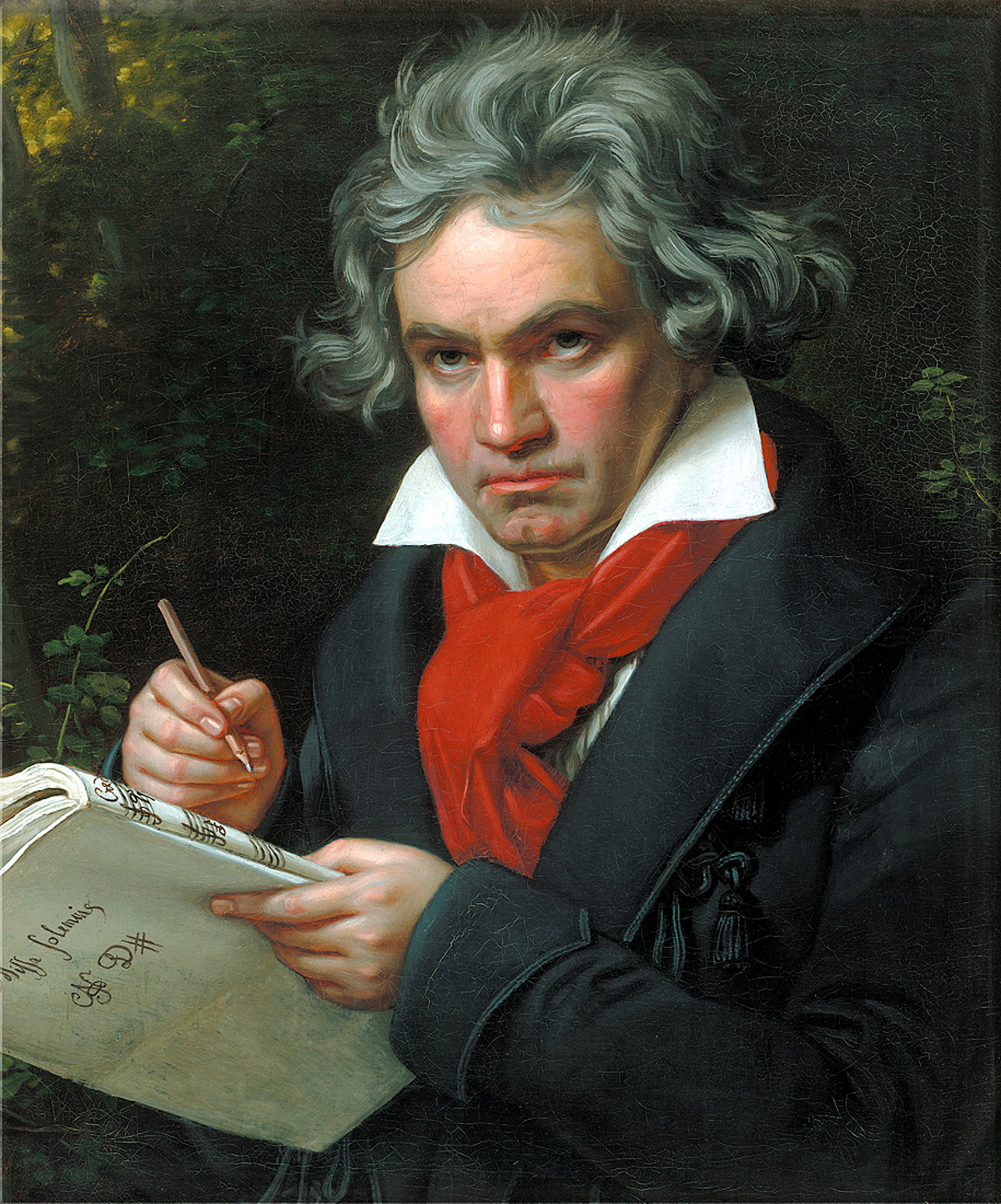
Composer of the heroic interior. Beethoven took the inherited classical forms and pushed them open, until the symphony could carry the human voice and the piano sonata could end in silence. He wrote some of his greatest works after he had gone deaf, hearing the music in the only place that mattered. From the four-note knock of Fate to the Ode to Joy, the listener walks the same passage from struggle into light.
Fate knocks at the door. The four-note motif that opened a new century of music, here in 432 Hz tuning.
The Ninth in full, in 432 Hz. The first symphony to call on the human voice, ending in the Ode to Joy.
The most famous symphony ever written. Four notes, and the door opens.
Bright energy and classical proportion. Composed at Heiligenstadt, while he wrote his testament about deafness.
His symphonic debut. Haydn's pupil already showing his own unmistakable voice.
Compact, witty, exuberant. Beethoven himself called it "my little Symphony in F."
The Heroic. Originally dedicated to Napoleon, then scratched out in fury. Revolution turned into music.
An early symphony of bright energy, written while he confronted the first signs of his deafness.
A walk through the country, a thunderstorm, a thanksgiving. Nature as inner landscape.
The final chorale of the Ninth, on its own. Schiller's poem of universal brotherhood, set to one of the most loved melodies in history.
The most famous piano miniature ever written. A small dedication; a perfect line that everyone recognizes from the first note.
The whole sonata, end to end. The hushed first movement gives it its name; the storm of the finale earns it.
Wagner called it the apotheosis of the dance. Pure rhythmic energy turned spiritual.
The lyrical sister of the Eroica. Bright, balanced, deceptively classical; the calm before the Fifth.
The country walk in standard tuning. Birdsong and brook written into the score.
A short serenade for violin and orchestra. Tender, classical, unhurried.
A second complete reading. The same arc of stillness, storm, and resolution.
His last piano sonata. Two movements, then silence. The late style at its most distilled.
The full work in standard tuning. Three movements; one continuous arc.
For long sessions of work, study, or contemplation.
Nearly five hours of the most luminous Beethoven, in 432 Hz tuning. For the longest sessions of work or contemplation.
The Ninth from start to finish. Seventy-two minutes ending in the Ode to Joy.
A long anthology of the most loved pieces. Just under two hours of classical clarity.