Dante Symphony
After Dante's Divine Comedy
Liszt's symphony after the Divine Comedy. Inferno, Purgatorio, Magnificat. The Romantic imagination at its full reach.
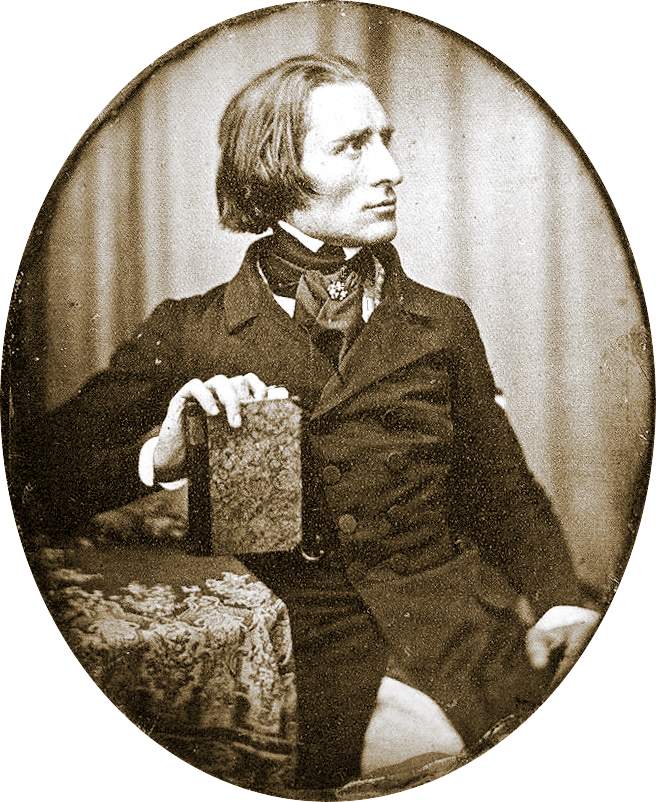
Composer of the keyboard sublime. Liszt extended the piano until it could carry the orchestra and the contemplative cell at once. He invented the symphonic poem, gave Europe its picture of the touring virtuoso, and ended his life in minor orders as Abbé Liszt. From the wild ride of Mazeppa to the silence of Vision, the listener walks the whole arc he walked.
Liszt's symphony after the Divine Comedy. Inferno, Purgatorio, Magnificat. The Romantic imagination at its full reach.
His most popular symphonic poem. "What is our life," asked Liszt, "but a series of preludes to that unknown song whose first solemn note is sounded by Death?"
One of the great rhapsodies. Hungarian folk material taken to the height of virtuoso pianism.
The most famous of the three Liebesträume. A nocturne of remembered tenderness.
The final and most demanding of the cycle. A snowstorm sweeping the keyboard.
Storm-passion turned into pure piano line.
A short waltz, light-footed and unhurried.
Evening harmonies. The ringing of distant bells across the keyboard.
The wild ride bound to a runaway horse, transcribed for the keys. One of the most spectacular études ever written.
The heroic étude. After Beethoven, in Liszt's hands.
The wild hunt; pounding hooves under the fingertips.
A short opening to the cycle of twelve.
A reminiscence. The most tender of the cycle, a turn inward.
Will-o'-the-wisps, glittering across the keyboard. Liszt at his most luminous.
A landscape in piano. All light and stillness.
A meditation. The slow inner gaze of the cycle.
A short, fleet étude of pure motion.